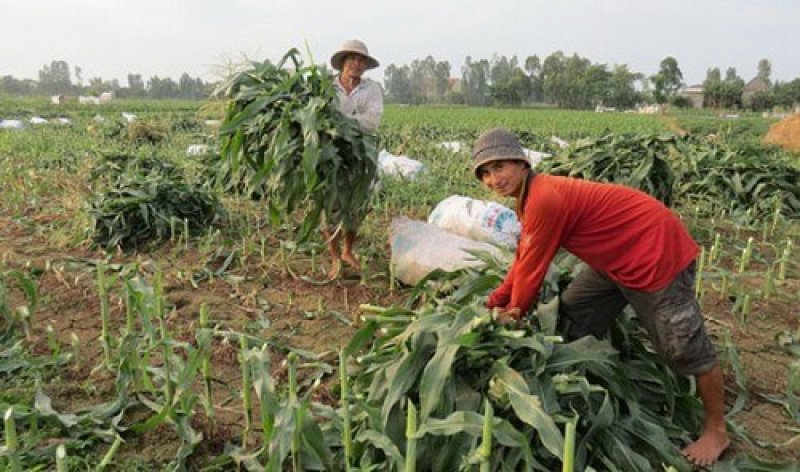
Vietnam approves GM corn as animal feed to reduce dependence on imports

Nxt BSrL

Vietnamese farmers nationwide are now able to plant three varieties of genetically-modified (GM) corn from the Swiss firm Syngenta, according to a new government’s rule.

The three varieties are NK66 BT, NK66 GT and NK66 BT/GT and will be supplied to corn farms nationwide with each variety being distributed to specific regions, said the decision from the Ministry of Agriculture and Rural Development.

Pham Dong Quang, director of the Department of Crop Production, said the three varieties can resist pest and herbicide as well as produce higher yields.

“GM corn will be used for animal feed only and thus, it does not require special labeling,” he said.

Kumar Datta, Syngenta Vietnam country director, said the company will coordinate with provincial agricultural agencies on plans to widely spread the varieties for better income of the farmers.

‘Jumping the gun’

Those developments were in line with a 2006 ambitious plan to develop biotech crops as part of a “major program for the development and application of biotechnology in agriculture and rural development.”

The plan aimed to cultivate Vietnam’s first GM crops by 2015 and have 30-50 percent of the country’s farmland covered with genetically modified organisms by 2020.

An increasing number of Vietnamese officials and scientists have touted the need to grow GM corn to reduce Vietnam’s dependence on imports.

Vietnam currently imports 1.5 million tons of corn for feeding animals every year from Brazil, Argentina, and the US, including GM varieties, according to the agriculture ministry.

Read full, original article: Vietnam approves commercial crops of GMO corn to cut imports

{{ reviewsTotal }}{{ options.labels.singularReviewCountLabel }}
{{ reviewsTotal }}{{ options.labels.pluralReviewCountLabel }}
{{ options.labels.newReviewButton }}
{{ userData.canReview.message }}

Related Articles

Infographic: Global regulatory and health research agencies on whether glyphosate causes cancer

Infographic: Global regulatory and health research agencies on whether glyphosate causes cancer

Does glyphosate—the world's most heavily-used herbicide—pose serious harm to humans? Is it carcinogenic? Those issues are of both legal and ...

Most Popular

ChatGPT-Image-Jun-11-2026-01_15_03-PM
Selective Pressure, Selective Silence
ChatGPT Image Jun 3, 2026, 03_54_37 PM
Viewpoint: “Turn on, tune in, drop out”—Kennedy embraces the Timothy Leary psychedelic revolution
Screenshot 2026-05-26 at 10.15
Viewpoint: Double standard—Why does the wellness industry get a free pass while Big Healthcare is treated as morally suspect?
Screenshot-2026-06-05-at-1.44.09-PM
Viewpoint: Scientists have scrapped the worst-case climate scenario. Is that proof that climate change is a hoax, as Trump claims?
Screenshot-2026-06-11-at-3.40.06-PM
'Toxin' detox: A gastroenterologist weighs in on $71 billion health trend
Screenshot-2026-06-11-at-4.00.17-PM
Gen Z burned by sunscreen misinformation and tanning myths
Screenshot-2026-06-05-at-2.12.30-PM
Some plants can poison you. So how did humans figure out what is safe to eat?
ChatGPT-Image-Jun-11-2026-10_34_44-AM-2
Will hi-tech genetic fortune-telling really help parents make healthier children?
Screenshot-2026-06-03-at-3.33.44-PM
Viewpoint: Vaccine deniers are attacking a life-saving Vitamin K shot for newborns that isn’t even a vaccine
Screenshot-2026-06-08-at-1.35.30-PM
Viewpoint: Social media and fake natural health propaganda fuel surge in use of mostly useless supplements
Credit: ACSH
Viewpoint: Who and what’s to blame for the surge in vaccine-preventable diseases?
ChatGPT Image Jun 3, 2026, 03_14_43 PM
Viewpoint: How Earthjustice became the poster child for the abuse of special interest activist funding
ChatGPT-Image-Jun-10-2026-12_57_24-PM
Viewpoint: Why gene-editing babies is moral and certain to happen
glp menu logo outlined

Get news on human & agricultural genetics and biotechnology delivered to your inbox.