Anti-GMO campaigners often attack Monsanto and other large agricultural companies for suing farmers who illegally save their seeds and replant them. But most non-GMO seeds as well as genetically modified versions are patent protected for companies to recoup their investment costs. If these intellectual protection rights were removed, would farmers go back to saving seeds and replanting them in subsequent years?
In some cases, yes. Some crops are able to produce viable seed that can be saved and replanted to yield offspring that perform similarly to their parents. But for other crops, most notably hybrid corn, no. In the case of crops that have been improved by hybridization in conventional breeding, saving seeds for replanting doesn’t make sense as any saved seed will not perform as well as their parents.
Let’s take a look at the process of hybridization in conventional breeding. Hybridization is when breeders take two distinct, but related plants and mate them, commonly by pollinating the plants by hand. For example, a breeder could cross a big corn plant that is susceptible to disease with another that is small but more resistant to disease to produce a hybrid plant that is both big and resistant to disease. This resulting hybrid plant is called F1 hybrid (first-filial generation).
F1 hybrids have the advantage of a phenomenon known as hybrid vigor. Charles Darwin conducted experiments with corn, reported in 1876, that involved crossing a corn plant with itself (in-breeding) and different corn plants together (hybridizing) over several generations. His results: the hybrids were bigger, more robust, and generally outperformed the inbreds. In Darwin’s terms, the hybrids had “innate constitutional vigor.” The inbreds, however, suffered from “inbreeding depression.”
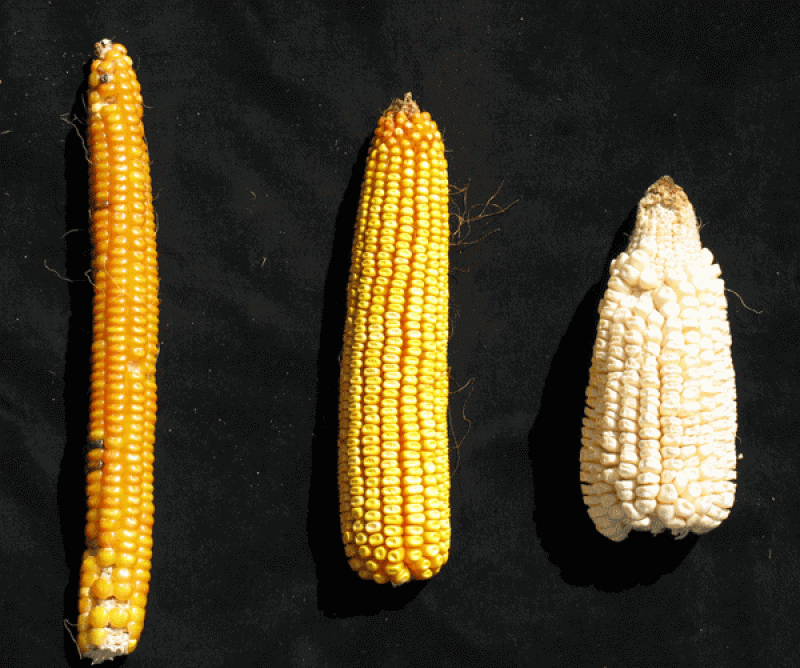
But the inbreds are an important component of the hybrid corn that we know today. F1 hybrid corn comes from crossing pure inbred corn plants. When breeders repeatedly force a specific corn plant to self-pollinate and in-breed, subsequent generations become more and more similar to the parent. An inbred plant is considered “pure” when its offspring is almost identical to itself, usually after seven to ten continuous generations of self-pollination. In 1908, scientists George Shull and Edward East, working independently, crossed two inbred corn plants and produced much more superior hybrids. The resulting plants had good vigor, greater yields, were more uniform, robust and predictable.
Here’s the catch: if F1 hybrid seeds are saved and planted the next year, the farmer would not get the same crop. That is because the so-called F2 generation, offspring of the F1 hybrids, typically display an unpredictable mixture of characteristics from their parents instead of being similar. The advantage of hybrid vigor in F1 hybrids can only be achieved in the first generation offspring of inbred varieties. So to receive the benefits of hybrid seeds, farmers would have to buy them each year. The breeder simply had had to keep the identities of the hybrid’s parents a secret.

Before the advent of intellectual protection rights for plants and genetically modified crops, farmers chose to buy hybrid corn year after year, because they performed better consistently. The first U.S. Plant Patent Act in 1930 established patent rights for new varieties of asexually propagated plants and seed-propagated plants were not protected until 1970; F1 hybrids were only added to the list of patentable plants in 1994. The first commercial sales of hybrid corn began in 1924 and in the 1930s, the advantage of hybrid corn became clear when they resisted and survived severe drought, as compared to the crops from saved seed. By 1965, 95 percent of the corn planted in the U.S. was F1 hybrids. Other crops have also been successfully hybridized, including sorghum, sunflower, broccoli, tomatoes and onions.
So, the claim that farmers would be able to save their seeds if only the patent rights of seed companies were curtailed and GM seeds were removed from the marketplace is not completely true.
Sources:
- “Biotechnology provides new tools for plant breeding,” UC Davis Seed Biotechnology Center Publication
- “90 Years Ago: The Beginning of Hybrid Maize,” Genetics Society of America
- “Seed industry structure is characterized by growth and consolidation,” USDA Economic Research Service
- “Impact of 1936 corn-belt drought on American farmers’ adoption of hybrid corn,” National Bureau of Economic Research working paper
Additional Resources:
- “Patents and GMOs: Should biotech companies turn innovations over to public cost-free?” Genetic Literacy Project
- “View from an Iowa farm: In choosing seeds, ‘I’m no pawn of Monsanto’,” Genetic Literacy Project