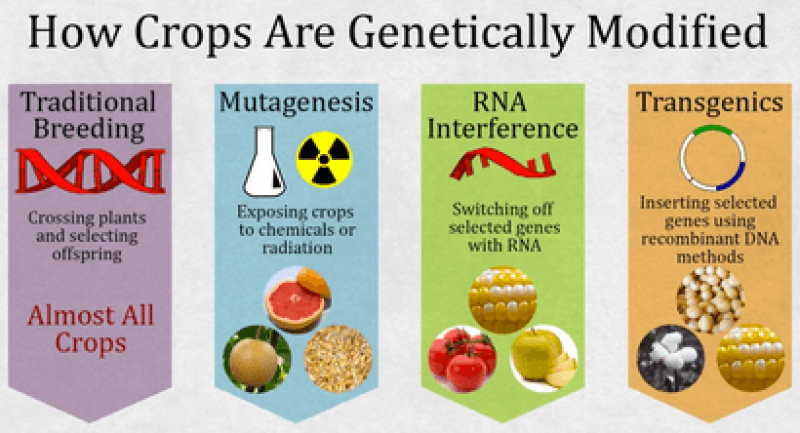
Why do scientists say that genetic engineering of crops is just the “latest chapter” in 10,000 years of high-tech agriculture? Or that genetic engineering is just a more precise way to breed plants compared to conventional breeding? Plants swap genes even without the help of human beings when they reproduce sexually, and our ancestors guided the process to develop crops suitable for agriculture. This GLP infographic presents four main ways in which crops have been genetically modified by humans: traditional breeding, mutagenesis, RNA interference and transgenics.
(Click to view high resolution image)
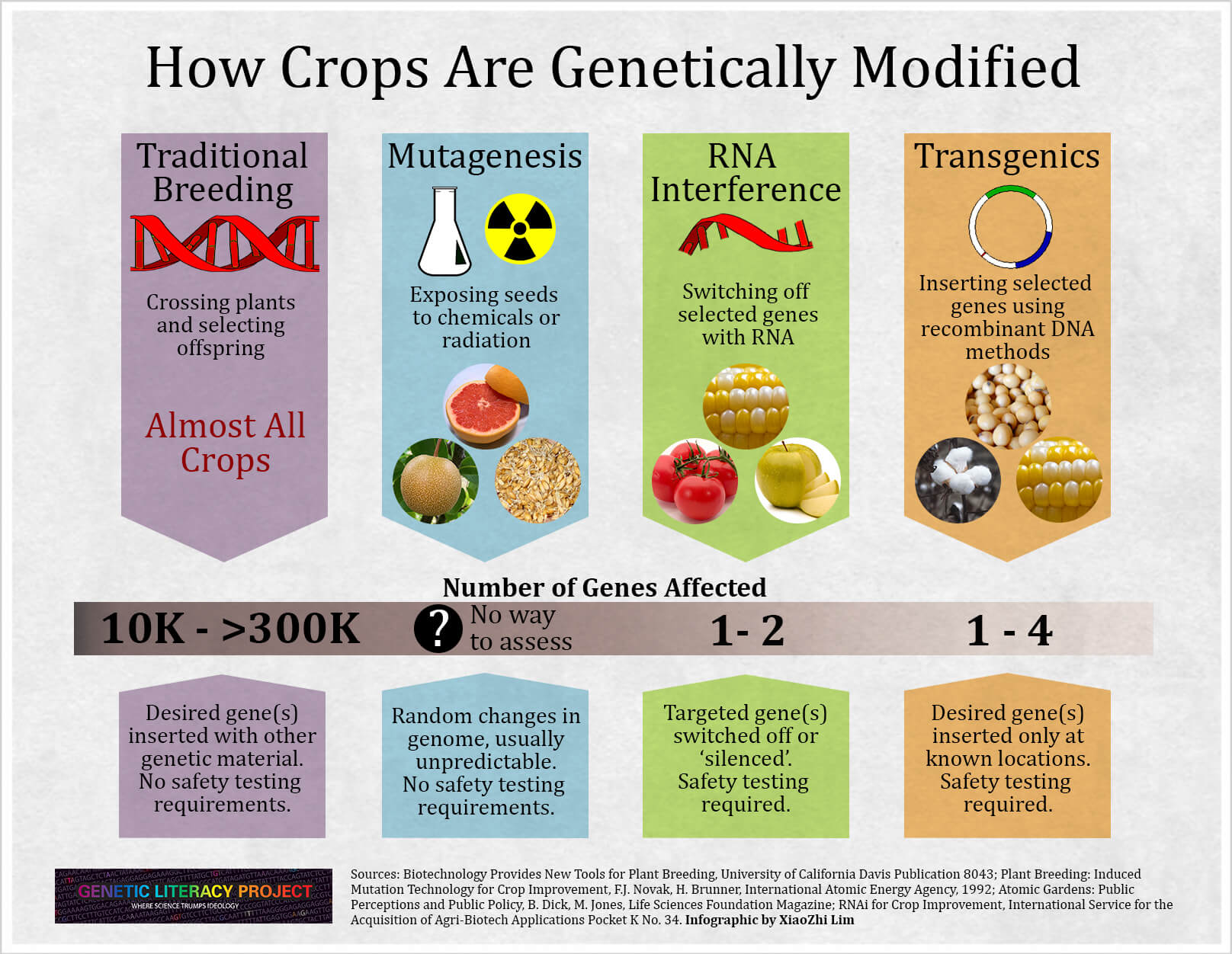
Traditional breeding of crops existed since the beginning of human civilization. Today, it encompasses a whole range of techniques, including high-tech ones like marker-assisted breeding. In traditional breeding, lots of genes are swapped at once, a process that can be “messy,” as described by Cornell plant breeder Margaret Smith. While breeders have been able to cross plants with their wild relatives (called a wide cross) to produce hybrids, the possibilities of using genes from distantly-related or other species are limited.

In the 1920s and 1930s, scientists explored the effect of radiation on a wide variety of plants. They found that applications of radiation produced mutations in plant genomes, creating plants that were different from the original. The Rio Star grapefruit was developed when Texas scientist Richard Hensz irradiated Ruby Red grapefruit seeds with X-rays. The new grapefruit had darker flesh and greater resistance to cold, which helped it survive a severe freeze in 1983 that killed other grapefruit trees. Since the 1940s, thousands of other crops have been produced with mutagenesis.
As molecular techniques in biology became available around the 1970s, scientists began to look more precisely at ways to alter genes in plants. RNA interference techniques allow scientists to switch off genes coding for undesired traits precisely, while recombinant DNA techniques allow them to insert genes coding for desired traits precisely. Other than allowing more precision in genetic modification, these molecular techniques also open up the possibilities of using genes from other species.
Additional Resources:
- “The 10 minor realizations that flipped my thinking about GMOs,” Biology Fortified
- “GMOs vs. mutagenesis vs. conventional breeding: Which wins?” Genetic Literacy Project
- “More Frankenfood Paradox!” Illumination