Plants may experience consciousness — but in a different way than humans

Screen Shot at PM
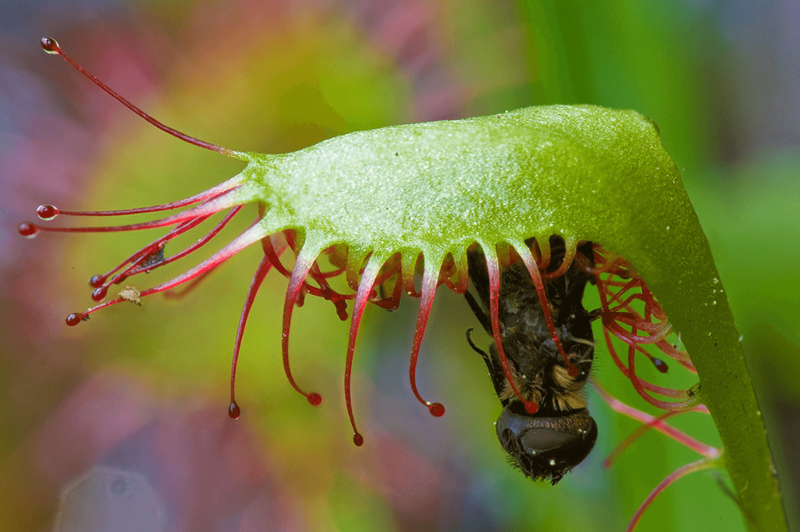
A sundew plant catching and eating a fly.

Like us, plants possess receptors, microtubules and sophisticated intercellular systems that likely facilitate a degree of spatio-temporal consciousness. Instead of generating a pattern of colors, the particles of light bouncing off a plant produce a pattern of energy molecules — sugar — in the chlorophyll in its stems and leaves. Light-stimulating chemical reactions in one leaf cause a chain reaction of signals to the entire organism via vascular bundles.

Neurobiologists have discovered that plants also have rudimentary neural nets and the capacity for primary perceptions. Indeed, the sundew plant (Drosera) will grasp at a fly with incredible accuracy — much better than you can do a fly-swatter. Some plants even know when ants are coming towards them to steal their nectar and have mechanisms to close up when they approach. Scientists at Cornell University discovered that when a hornworm starts eating sagebrush (Artemisia tridentata), the wounded plant will send out a blast of scent that warns surrounding plants — in the case of the study, wild tobacco (Nicotiana attenuata) – that trouble is on its way. Those plants, in turn, prepare chemical defenses that send the hungry critters in the opposite direction. Andre Kessler, the lead researcher, called this “priming its defense response.” “This could be a crucial mechanism of plant-plant communication,” he said.

The GLP aggregated and excerpted this blog/article to reflect the diversity of news, opinion, and analysis. Read full, original post: Are Plants Aware?

{{ reviewsTotal }}{{ options.labels.singularReviewCountLabel }}
{{ reviewsTotal }}{{ options.labels.pluralReviewCountLabel }}
{{ options.labels.newReviewButton }}
{{ userData.canReview.message }}

Related Articles

Infographic: Global regulatory and health research agencies on whether glyphosate causes cancer

Infographic: Global regulatory and health research agencies on whether glyphosate causes cancer

Does glyphosate—the world's most heavily-used herbicide—pose serious harm to humans? Is it carcinogenic? Those issues are of both legal and ...

Most Popular

Screenshot-PM-24
Viewpoint: The herbicide glyphosate isn’t perfect. Banning it would be far worse.
ChatGPT-Image-Mar-27-2026-11_27_05-AM
The myths of “process”: What science says about the “dangers’ of synthetic products and ultra-processed foods
d-b
Blocked arteries, kidney stones, nausea, constipation, fatigue: Long list of health problems caused by too much vitamin D 
ChatGPT-Image-Mar-3-2026-01_17_14-PM
MAHA wellness influencers deride proven anxiety medications, tout lifestyle fixes
ChatGPT-Image-Apr-30-2026-05_00_48-PM
Wellness grifter physician turned wellness influencer out as surgeon general nominee
Screenshot-2026-04-29-at-11.31.42-AM
Dad brains: Only women undergo bodily changes during and after childbirth? Think again.
ChatGPT-Image-Apr-28-2026-12_46_14-PM-2
Kennedy has quietly stopped touting problematic raw milk. Health concerns aren’t why
79d03212-2508-45d0-b427-8e9743ff6432
Viewpoint: The Casey Means hustle—Wellness woo opportunism dressed up as medical wisdom
ChatGPT-Image-Feb-16-2026-01_04_32-PM
Raw milk myth wake-up call
glp menu logo outlined

Get news on human & agricultural genetics and biotechnology delivered to your inbox.