
Drug addiction may be fueled by genetics, not just poor judgment

cocaine addiction

Scientists at the University of British Columbia have genetically engineered a mouse that does not become addicted to cocaine, adding to the evidence that habitual drug use is more a matter of genetics and biochemistry than just poor judgment.

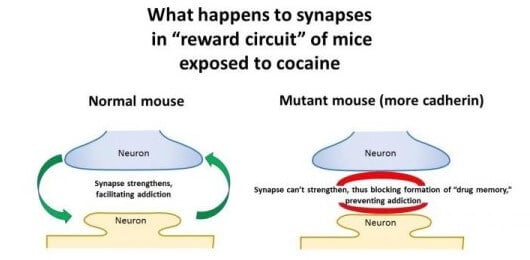
The mice they created had higher levels of a protein called cadherin, which…helps strengthen synapses between neurons….

[After injecting cocaine into mice, researchers found that]ย the normal mice almost always gravitated to the cocaine-associated compartment, while the mice with extra cadherin spent half as much time there — indicating that these mice hadn’t formed strong memories of the drug.

“By preventing the synapses from strengthening, we prevented the mutant mice from ‘learning’ the memory of cocaine, and thus prevented them from becoming addicted,”ย says graduate student and co-author Andrea Globa.
x
A diagram showing synapses in the reward circuit of mice when exposed to cocaine: on left, a normal mouse, and on right, a mouse with increased levels of cadherin. Credit: University of British Columbia.

Their finding provides an explanation for previous studies showing that people with substance use problems tend to have more genetic mutations associated with cadherin and cell adhesion. As studies such as this one illuminate the biochemical underpinnings of addiction, it could lead to greater confidence in predicting who is more vulnerable to drug abuse — and enable people to act on that knowledge.

[The study can be found here.]

The GLP aggregated and excerpted this blog/article to reflect the diversity of news, opinion, and analysis. Read full, original post:ย Scientists create mouse that resists cocaine’s lure

{{ reviewsTotal }}{{ options.labels.singularReviewCountLabel }}
{{ reviewsTotal }}{{ options.labels.pluralReviewCountLabel }}
{{ options.labels.newReviewButton }}
{{ userData.canReview.message }}

Related Articles

Infographic: Global regulatory and health research agencies on whether glyphosate causes cancer

Infographic: Global regulatory and health research agencies on whether glyphosate causes cancer

Does glyphosateโ€”the world's most heavily-used herbicideโ€”pose serious harm to humans? Is it carcinogenic? Those issues are of both legal and ...

Most Popular

Screenshot 2026-05-26 at 10.15
Viewpoint: Double standardโ€”Why does the wellness industry get a free pass while Big Healthcare is treated as morally suspect?
ChatGPT-Image-Jun-4-2026-01_27_58-PM
Viewpointโ€”N.A.D.+: Why Gwenyth Paltrowโ€™s heralded anti-aging supplement doesnโ€™t work
ChatGPT-Image-Jun-4-2026-11_49_36-AM-2
โ€˜You donโ€™t understand Tolkienโ€™: Skeptic Pope trolls tech giants about the exaggerated, risk-less benefits of AI
Screenshot 2025-07-30 at 10.48
Can gene editing eliminate Down syndrome? Scientists have done it in lab-grown cells
ChatGPT-Image-Mar-10-2026-01_39_01-PM
Viewpointโ€”โ€œMiracle moleculeโ€ debunked: Why acemannan supplements donโ€™t work
tick-DNA
GLP podcast: Spread meat allergy with gene-edited ticks? Bioethicists pose vile โ€˜thought experimentโ€™
Screenshot-2026-06-03-at-1.24.46-PM
Challenging anti-GMO disinformation: Why genetically-tweaked crops offer bushels of benefits
downsyndrome_compilation_MID_1
CRISPR breakthrough that can remove the chromosome responsible for Down syndrome raises ethical questions
Screenshot-2026-06-04-at-12.05.08-PM
Cases of brain inflammation surge as U.S. measles pandemic approaches 2000
ChatGPT Image May 26, 2026, 08_42_17 AM (1)
Viewpoint: Greenpeace and poison: How environmental advocacy groups rely on compliant (and often ignorant) journalists to spread disinformation and spark litigation
ChatGPT-Image-May-26-2026-07_51_21-AM-2
Viewpoint: There are more than 1,000 chemicals in a cup of coffeeโ€”including many substances that can cause cancer. Why isnโ€™t it banned?

Sorry. No data so far.

glp menu logo outlined

Get news on human & agricultural genetics and biotechnology delivered to your inbox.