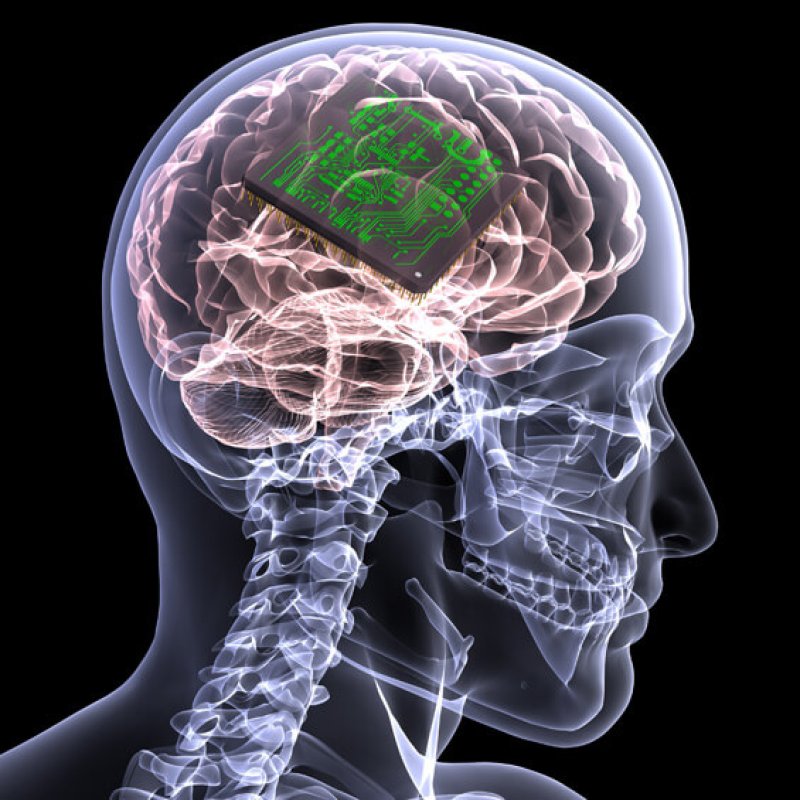
Brain implants might soon restore vision to the blind, improve digestion, relieve PTSD symptoms

memory chip brain implant
[Brain implant experiments] like those that let a paralyzed person swig coffee using a robotic arm, or that let blind people “see” spots of light, have proven the huge potential of computers that interface with the brain. But the implanted electrodes used in such trials eventually become useless, as scar tissue forms that degrades their electrical connection to brain cells.

[However,] tests will begin in monkeys of a new implant for piping data into the brain that is designed to avoid that problem. [Led by Harvard researchers,] the project is intended to lead to devices that can restore vision to blind people long-term…[The device will] go beneath the skull but can rest on the surface of an animal’s brain, instead of penetrating inside the organ.

“There could be very nice applications in other parts of the body,” says Todd Coleman, an associate professor at the University of California, San Diego. He suggests the tiny coils [in the brain implant] could be used to modulate activity in…the human digestive system…to help people with conditions in which the gut doesn’t move food along as it should.

Bernard Casse, a researcher at the PARC research institute, owned by Xerox, where the new implant design was invented…says he is interested in exploring use of the technology on the vagus nerve in the chest to control symptoms of PTSD.

The GLP aggregated and excerpted this blog/article to reflect the diversity of news, opinion, and analysis. Read full, original post: This Technology Could Finally Make Brain Implants Practical

{{ reviewsTotal }}{{ options.labels.singularReviewCountLabel }}
{{ reviewsTotal }}{{ options.labels.pluralReviewCountLabel }}
{{ options.labels.newReviewButton }}
{{ userData.canReview.message }}

Related Articles

Infographic: Global regulatory and health research agencies on whether glyphosate causes cancer

Infographic: Global regulatory and health research agencies on whether glyphosate causes cancer

Does glyphosate—the world's most heavily-used herbicide—pose serious harm to humans? Is it carcinogenic? Those issues are of both legal and ...

Most Popular

Screenshot 2025-07-30 at 10.48
Can gene editing eliminate Down syndrome? Scientists have done it in lab-grown cells
ChatGPT Image May 26, 2026, 08_42_17 AM (1)
Viewpoint: Greenpeace and poison: How environmental advocacy groups rely on compliant (and often ignorant) journalists to spread disinformation and spark litigation
ChatGPT Image May 26, 2026, 08_21_36 AM
Limiting gender affirming interventions: Trump administration targets Texas even though it already bans youth access
Screenshot-2026-05-28-at-1.36.28-PM
Viewpoint: Can mRNA research survive the Trump administration?
Screenshot-2026-06-03-at-1.24.46-PM
Challenging anti-GMO disinformation: Why genetically-tweaked crops offer bushels of benefits
ChatGPT-Image-Jun-2-2026-03_04_17-PM
Viewpoint: Why the hyper-promoted doping ‘enhanced games’ pseudo Olympics flopped
ChatGPT-Image-May-26-2026-07_51_21-AM-2
Viewpoint: There are more than 1,000 chemicals in a cup of coffee—including many substances that can cause cancer. Why isn’t it banned?
ChatGPT-Image-Jun-3-2026-12_33_40-PM-2-1
Viewpoint—The end of ‘ivory tower science’: What does that even mean, and what comes next
Picture1
Sounds we can’t hear — the hidden planetary signals behind science, fear, and misinformation
ChatGPT-Image-Mar-10-2026-01_39_01-PM
Viewpoint—“Miracle molecule” debunked: Why acemannan supplements don’t work
tick-DNA
GLP podcast: Spread meat allergy with gene-edited ticks? Bioethicists pose vile ‘thought experiment’
ChatGPT-Image-Jun-2-2026-11_39_58-AM
Viewpoint: Who is RFK, Jr.’s newly-appointed CDC senior counselor, Sara Brenner — Vaccine skeptic and self-proclaimed “MAHA mom”
glp menu logo outlined

Get news on human & agricultural genetics and biotechnology delivered to your inbox.