Smartphone app diagnoses genetic diseases with a snapshot

face gene x q crop
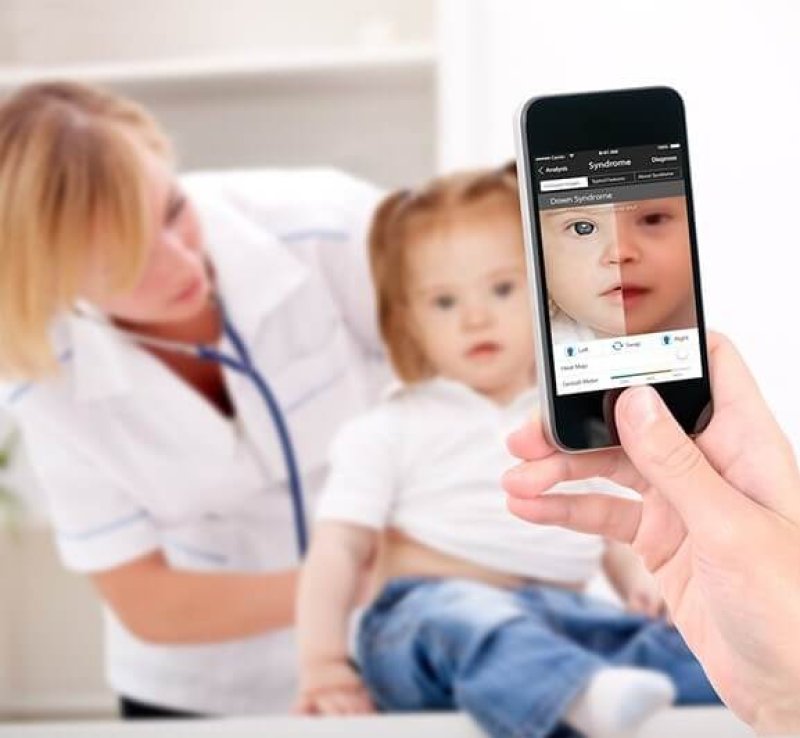
The app converts the image to data, primarily based on measurements of facial characteristics such as the distance between the eyes, the length of the face, and other ratios.
[When Omarย Abdul-Rahman, a clinical geneticist at the University of Mississippi Medical Center, had to provide a diagnosis for a young boy with distinct facial features and intellectual disabilities, he] turnedย to a new tool in a geneticistโ€™s arsenal, an app based on facial recognition software that helps identify genetic conditions based on facial features. The app suggested, with a high degree of certainty, a condition he had considered [and a test] confirmed that the boy had Mowat-Wilson syndrome….

Face2Gene, the tool Abdul-Rahman used, was created by the Boston startup, FDNA. The company uses facial recognition software to aid clinical diagnoses of thousands of genetic conditions, such as Sotos syndrome, Kabuki syndrome, and Down syndrome.

[T]here are more than 7,000 other genetic conditions that arenโ€™t always so easy [to diagnose]. The founders of FDNA…thought it might be possible to use similar techniques to match facial characteristics to genetic conditions.

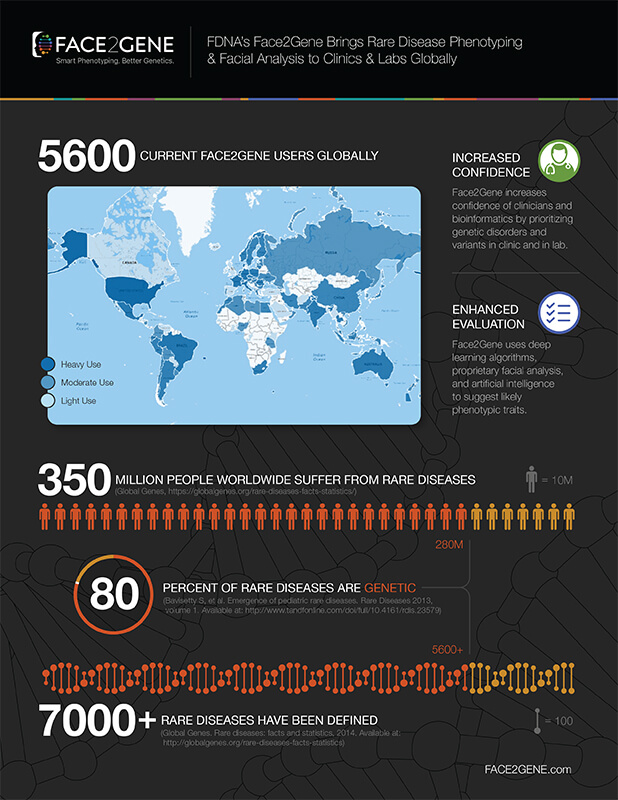
Face2Geneโ€™s user pool has grown quickly since the app was released in 2014โ€”more than 65 percent of clinical geneticists worldwide use itโ€”and as it grows, the tool becomes more robust.

face gene map infographic v
When a geneticist confirms the diagnosis of an uploaded photo, the app incorporates that in its database, creating a sort of crowdsourced loop. Credit: Smithsonian.


The GLP aggregated and excerpted this blog/article to reflect the diversity of news, opinion, and analysis. Read full, original post:ย This App Uses Facial Recognition Software to Help Identify Genetic Conditions

{{ reviewsTotal }}{{ options.labels.singularReviewCountLabel }}
{{ reviewsTotal }}{{ options.labels.pluralReviewCountLabel }}
{{ options.labels.newReviewButton }}
{{ userData.canReview.message }}

Related Articles

Infographic: Global regulatory and health research agencies on whether glyphosate causes cancer

Infographic: Global regulatory and health research agencies on whether glyphosate causes cancer

Does glyphosateโ€”the world's most heavily-used herbicideโ€”pose serious harm to humans? Is it carcinogenic? Those issues are of both legal and ...

Most Popular

Screenshot 2025-07-30 at 10.48
Can gene editing eliminate Down syndrome? Scientists have done it in lab-grown cells
ChatGPT-Image-Mar-10-2026-01_39_01-PM
Viewpointโ€”โ€œMiracle moleculeโ€ debunked: Why acemannan supplements donโ€™t work
Screenshot 2026-05-26 at 10.15
Viewpoint: Double standardโ€”Why does the wellness industry get a free pass while Big Healthcare is treated as morally suspect?
ChatGPT-Image-May-26-2026-07_51_21-AM-2
Viewpoint: There are more than 1,000 chemicals in a cup of coffeeโ€”including many substances that can cause cancer. Why isnโ€™t it banned?
Screenshot-2026-06-04-at-12.05.08-PM
Cases of brain inflammation surge as U.S. measles pandemic approaches 2000
Screenshot-2026-05-28-at-1.36.28-PM
Viewpoint: Can mRNA research survive the Trump administration?
ChatGPT Image May 26, 2026, 08_42_17 AM (1)
Viewpoint: Greenpeace and poison: How environmental advocacy groups rely on compliant (and often ignorant) journalists to spread disinformation and spark litigation
Picture1
Sounds we canโ€™t hear โ€” the hidden planetary signals behind science, fear, and misinformation

Sorry. No data so far.

glp menu logo outlined

Get news on human & agricultural genetics and biotechnology delivered to your inbox.