
One of the best strategies scientists have to determine what a particular gene does is to remove it from the genome then evaluate what the organism can no longer do…
It can take several years and millions of dollars to build a whole-genome knockout collection through targeted gene deletion.
The Princeton and Harvard researchers are the first to create a collection quickly and affordably, doing so in less than a month for several thousand dollars. Their strategy, called “Knockout Sudoku,” relies on a combination of randomized gene deletion and a powerful reconstruction algorithm.
Their approach began with steep pizza bills and a technique called transposon mutagenesis that ‘knocks out’ genes by randomly inserting a single disruptive DNA sequence into the genome.
[They] recruited undergraduates and graduate students to manually transfer 40,000 mutants out of petri dishes into separate wells using toothpicks. He offered pizza as an incentive, but after a full day of labor, they only managed to move a couple thousand mutants. “I thought to myself, ‘Wait a second, this pizza is going to ruin me,'” [Havard researcher Michael] Barstow said.

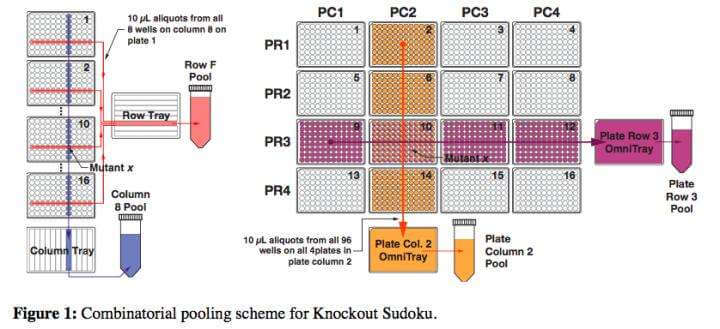
Instead, they decided to rent a colony-picking robot. In just two days, the robot was able to transfer each mutant microbe to individual homes in 96 well plates, 417 plates in total.
But still, after sequencing each of the pools, the researchers had an incredible amount of data. They knew the identities of all the mutants, but now they had to figure exactly where each mutant came from in the grid of plates. This is where the Sudoku aspect of the method came in.
The GLP aggregated and excerpted this blog/article to reflect the diversity of news, opinion, and analysis. Read full, original post: Researchers’ Sudoku strategy democratizes powerful tool for genetics research