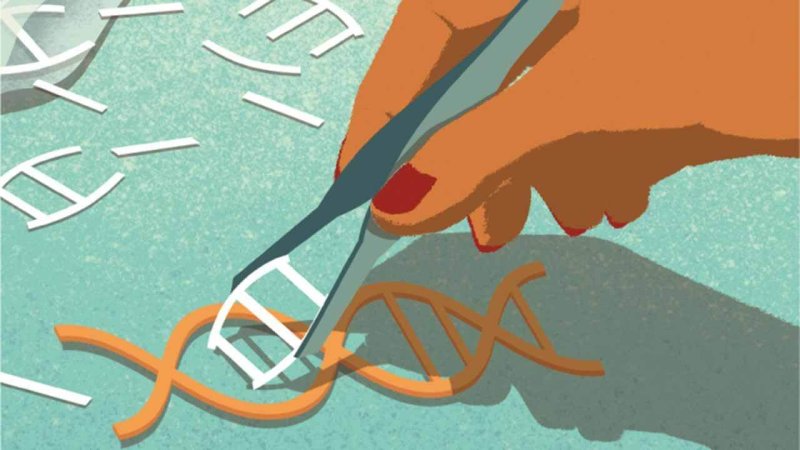
If Groucho Marx were alive today, he might say that the CRISPR-Cas9 system for genome editing is so simple that a 4-year-old child could use it to make some important discovery. But then he’d say, “Run out and find me a four-year-old child. I can’t make head or tail out of it.”
That actually would be a perfect perspective. You can buy a do-it-yourself (DIY) CRISPR genetic editing kit. One such kit is being offered by Josiah Zayner, a biologist at NASA’s Ames Research Center (ARC) and it should not surprise you that Ames is in Silicon Valley, the southern part of the San Francisco Bay area, where DIY biology is all the craze.
“I wondered how science would advance, if we could double the number of scientists,” Zayner noted in a recent podcast.
He offers two different kits: one is designed to let kitchen table scientists use CRISPR-Cas9 gene editing in prokaryotes (bacteria and archaea, organisms lacking a nucleus) and the other is for experimenting with eukaryotic organisms, the domain of Earth like that includes all multicellular life—like humans.
To get milage out of this new gene editing technology, one needs some basic background in biology and experience in a laboratory setting, so when you hear about DIY CRISPR it doesn’t mean that next year amateurs will be cooking up harmful biological entities in their kitchens. What it does mean, however, is that researchers in life sciences can get a CRISPR kit and use it for some new purpose and very likely succeed. It’s common today in biology to hear from someone, “Wow! I tried CRISPR and it worked the first time.” And that’s not something that usually happens when a scientist tries a new procedure for the first time.
Images of kitchen table ‘Franken-life’ forms
Last November, I wrote about a coming era when transgenic procedures will be so user-friendly, automated, and customizable, that amateurs will be making GMOs for their home gardens and other home applications. These kitchen table GMOs will be harmless products, like a synthetic coffee made by slipping genes needed for caffeine production into dandelions. For this type of application, specific genes would have to be purchased by anyone wishing to use them, and other than giving a plant the ability to make some enzyme that it doesn’t usually make there aren’t any other outcomes.

On the CRISPR end of things, a few months ago, Zayner received an email from a physician expressing “grave concerns” about providing lay people with gene editing tools. The writer went on to say: “Reprogramming bacteria or fungi could have serious ramifications, such as inadvertent or intended multi-drug resistance, faster multiplication, toxin production, and persisting potency when aerosolized.”
Other CRISPR-Cas9 gene editing kits, also from Northern California, have been met with criticism, leading to an article the San Jose Mercury News ran an article under a pearl-clutching headline: Bay Area biologist’s gene-editing kit lets do-it-yourselfers play God at the kitchen table. It summed up concerns about DIY gene editing as follows:
It’s a prospect that worries those who fear unregulated amateur biologists could unleash new pathogens but delights others who imagine the day when anyone could redesign the living world to create cheap drugs or clean fuels. This was once a Godlike power: moving genes from one living creature to another.
But such fears may turn out to be overblown. In a commentary in the prestigious journal Nature last March, Todd Kuiken, a senior program associate and principal investigator of the Wilson Center’s Synthetic Biology Project in Washington DC, wrote:
The reality is that the techniques and expertise needed to create a deadly insect or virus are far beyond the capabilities of the typical DIY biologist or community lab. Moreover, pursuing such a creation would go against the culture of responsibility that DIY biologists have developed over the past five years. In fact, when it comes to thinking proactively about the safety issues thrown up by biotechnology, the global DIY-biology community is arguably ahead of the scientific establishment.
“Zayner’s response to critics is that the kits “[aren’t] unsafe, and the great thing is the US government understands this. They are really interested in people innovating around genetic engineering, so there are not many laws that govern genetic engineering and research at home.”
One also needs to consider who the DIY biologists tend to be. In recent years, the academic environment has changed so that many people with a certain amount of science training are not in traditional academic tracts. Instead, they are doing other things such as working freelance for entrepreneurs in start-up companies, or—like this author—working in science communication and make their way into someone else’s lab from time to time when they have an idea for a good experiment.
David Warmflash is an astrobiologist, physician and science writer. Follow @CosmicEvolution to read what he is saying on Twitter.