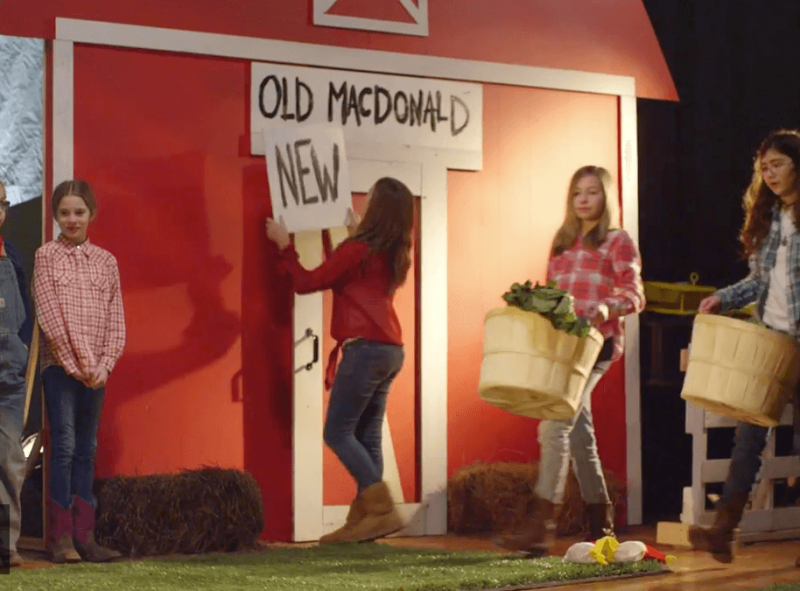
Late last week, a marketing group called “Only Organic” launched a YouTube video called “New MacDonald.” It depicts a group of children singing and acting out two versions of the classic song, intended to represent the differences between conventional and organic farming.
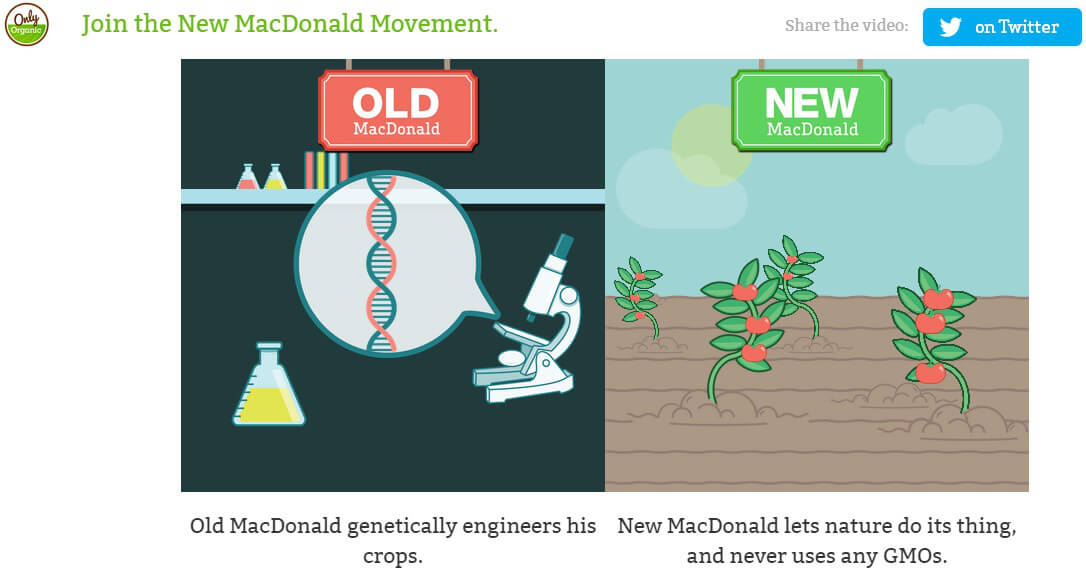
Over the weekend, my Twitter feed was filled with polarized reactions. Many of the organic organizations and activists I follow shared it enthusiastically while those on the “other side” were offended at the exaggerations. This dismay was accurately summarized by Dr. Steve Savage in a post on his Applied Mythology blog and reproduced on the Genetic Literacy Project, provocatively titled: Hate Speech For Profit: Organic Marketing Gone Bad. Here is the harsh dichotomy between “good” organics and “bad” conventional agriculture encapsulated in a graphic reproduced from the video:
Among the points Savage makes:
…this depiction of mainstream farming is not “playful.” … It is certainly not something that “furthers the conversation.” It is a malicious distortion that demonizes the work of the small minority of citizens who still farm.
Savage then goes on to ask what would happen if the shoe was on the other foot:
To put this in perspective, imagine if there was a comparable group to “Only Organic” from the “Conventional” side. They could hire an ad agency to produce a video and stills depicting fresh fruits, vegetables and other foods sitting in pools of fresh, steaming animal excrement or having the same coming out of a manure spreader onto a ripe crop of lettuce or strawberries. They could call Organic, “Poop-based agriculture” and label their own products as “grown without the use of animal fecal matter.” That would, of course, be an unfair, nasty depiction of the organic requirement to use only non-synthetic fertilizers.
(Though never done as brazenly as Savage suggests, this is, of course, also becoming a common tactic of the anti-organic movement. I’ve addressed it before.) Near the end of his post, Dr. Savage makes this observation:
I don’t believe that these marketing strategies reflect the ethics of real organic farmers, certainly none that I’ve met. Someone made the excellent suggestion that organic farmers could start a “not in my name” campaign to say that they don’t want to see the whole organic movement dragged down to this low level, and they don’t want to see their neighbors and fellow farmers maligned.
Within a week, this video had attracted more than 400,000 hits. The tactics and perceptions of marketing efforts have always been of interest to me. I’ve addressed the topic before in posts about the criticism of organic marketing techniques and most recently in a call to end this kind of “food fight.”
To a certain extent, any kind of advertising or marketing will always rely on simplified concepts and bold messages – it’s the nature of the medium. And I fully support efforts to create value-added, differentiated markets. But I believe it’s still fair to question the necessity of polarizing issues and the unintended consequences that can result.

In my opinion, organic marketers have no need to engage in questionable tactics. Firstly, they could instead choose to focus on the positive aspects of organic production, on the principles that serve as the foundation of the organic standards. Secondly, the organic market is booming – the U.S. market grew by 11.5 percent in 2014 to $35.1 billion!
Simply put, demand is not the issue – supply is. Although the scope and impact of organic imports is often exaggerated by critics of organic food, the inescapable reality is that North American production is failing to keep up with the growth in the market. If the organic sector is going to continue to meet consumer expectations at the highest level of integrity with respect to its own principles, it must find a way to encourage more American and Canadian farmers to make the transition to organic production.
And here’s the real irony: campaigns like “New MacDonald” threaten to alienate the very people the organic sector needs most right now: farmers. In my opinion, it’s time to start building bridges, not digging trenches.
Please let me know what you think – I’m especially interested in hearing from my friends in the organic community!
Rob Wallbridge is an organic farmer and consultant based in Western Quebec. He advocates for high-quality organic food and informed communities in agriculture. Follow him on Twitter as @songberryfarm and on his blog, The Fanning Mill.