Who do you trust to accurately report the scientific consensus on genetically modified foods?
On any contentious issue like GMOs, reaching agreement requires finding sources that all parties trust. This is an attempt to locate that common ground.
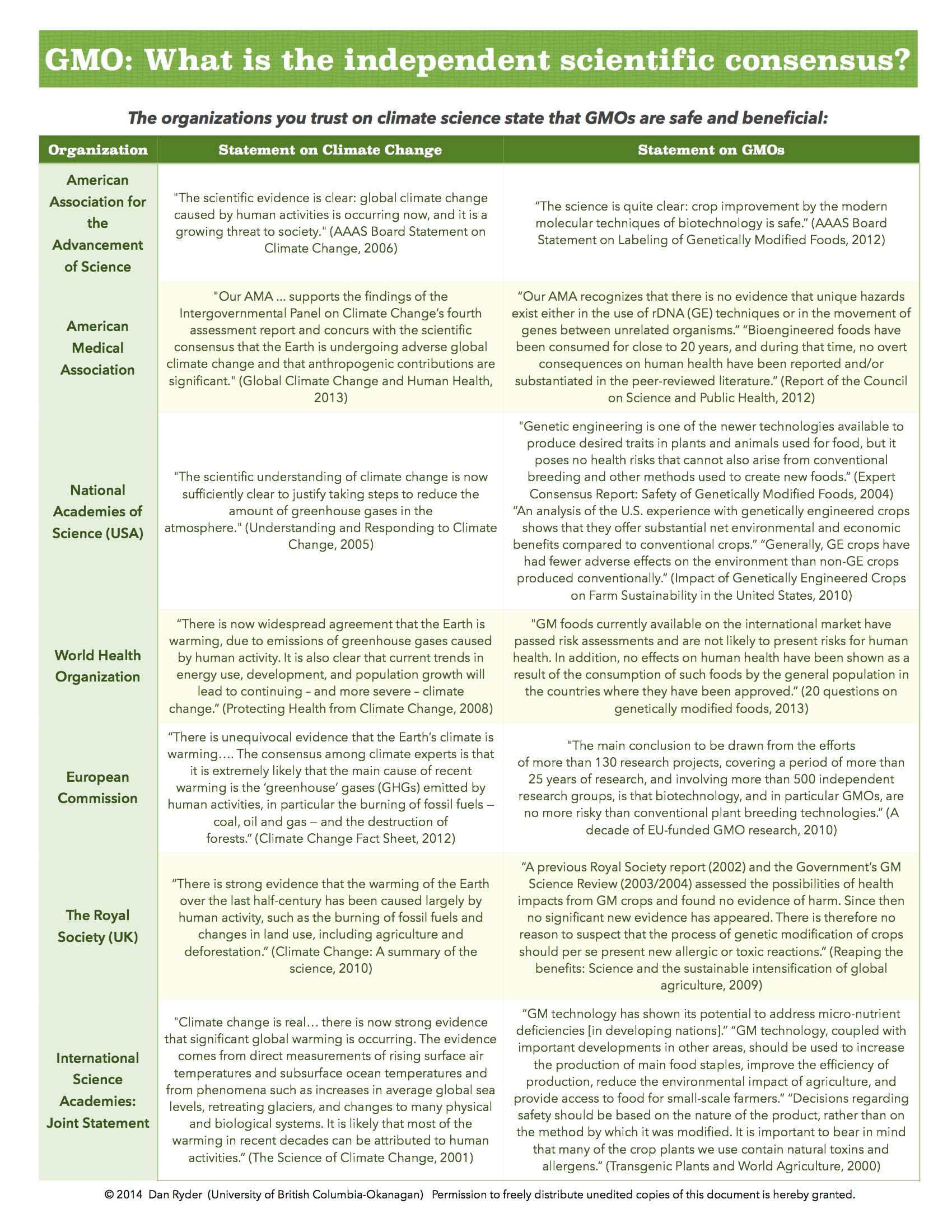
You trust the national and international science organizations that have stated human-caused climate change is a fact. These statements are issued based on thoroughly scrutinized independent expert reviews of hundreds or thousands of scientific papers, with due attention paid to potential bias. The organizations have stood by their statements in the light of further evidence, which has become only more supportive.
As detailed in the table, these organizations that you trust agree that climate change is real and alarming, and also that GMOs are safe for our health and for the environment. Their statements are careful, nuanced, and unbiased. For example, they point out that RoundUp herbicide tolerance in weeds is currently a problem, and encourage diversifying agricultural approaches (including alternative GMOs) to solve it. They agree that GMOs are not remotely the whole solution to improving the global food supply, although they can be an important part of it, as can organic methods. (Organic GMO anyone?) They agree that safe and beneficial GMOs should be made available at low or zero cost to developing nations. They agree that many herbicides and insecticides have toxic effects. All of these points run counter to Monsanto’s interests; these organizations make these claims for the same reason they make all their claims: because the science supports them.
Big Oil could not buy these organizations on climate change, or influence them by means of inserting a few biased members. But this means neither can Monsanto, with its tiny resources by comparison. (Exxon-Mobil’s net profits are 20 to 30 times Monsanto’s!)

You are encouraged to consult these sources for yourself, in the hope that we will be able to find common ground and join together in the important struggles ahead: against climate change denial, for independent science, and for food security in the face of climate change and a growing world population–with all the healthy and beneficial agricultural methods at our disposal. We’ll need them.
[Download pdf of graphic | Download pdf of comparison with summary]
Dan Ryder is Assistant Professor of Philosophy at the University of British Columbia, Okanagan. [email protected] | Danryder.com